
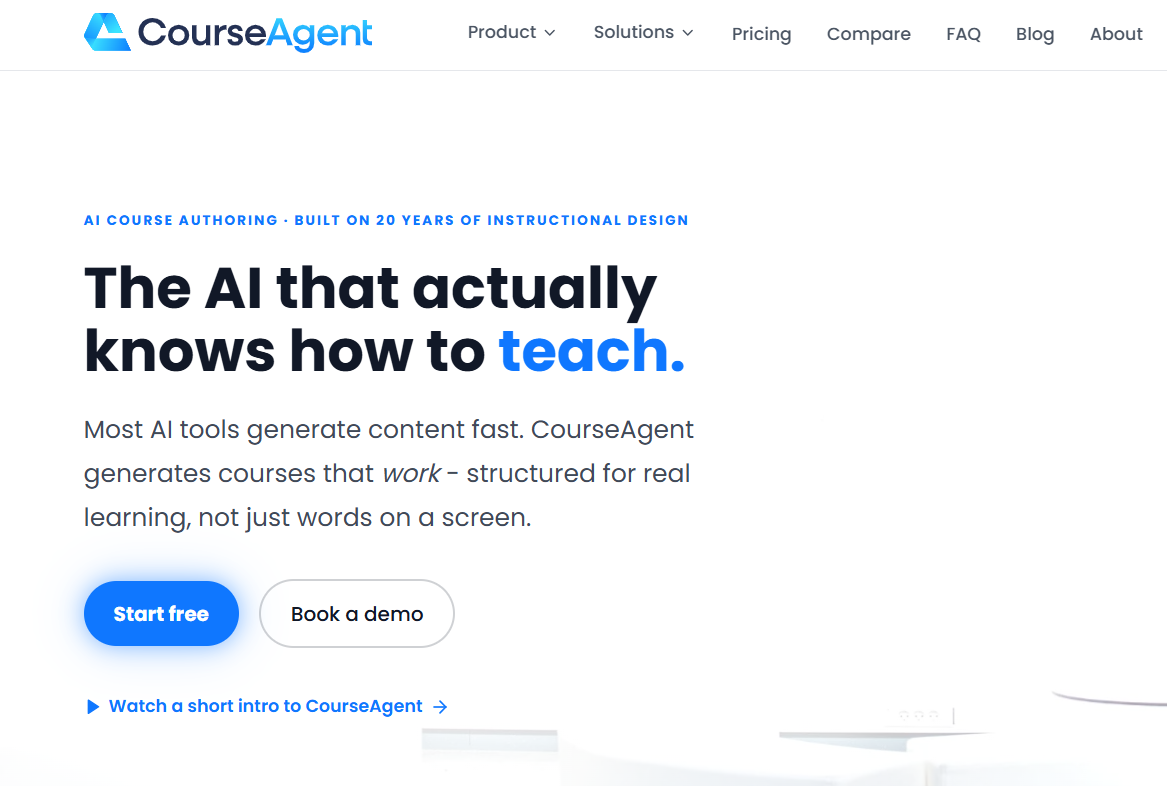
AI course authoring tool built on twenty years of instructional design
Infrastructure Development + Consultancy
Extracting twenty years of professional course authoring expertise into an AI taxonomy, a prompt architecture, and a content engine - turning tacit knowledge into a platform that teaches the way an experienced instructional designer would.
What it is
Pete Murr has spent over twenty years creating professional training courses for more than 800 organisations - healthcare trusts, local authorities, charities, professional bodies, and financial services firms. His first education business, ME Learning, built a reputation for craft: well-designed compliance and professional development training that works. Over 5,000 courses. A deep, instinctive understanding of what makes learning stick.
CourseAgent is the platform Pete built to make that expertise scalable. Not a generic AI content generator - a system where the instructional design principles aren't something you bring yourself, but are built into every output from the ground up. The platform generates complete, professionally structured courses from a brief, a document, a URL, or a YouTube video. It produces learning objectives, lesson plans, scenarios, interactive sections, knowledge checks, and assessments - all governed by the same design logic Pete has applied across two decades of professional practice.
The challenge was translation. Pete's expertise existed as tacit knowledge - instinctive, pattern-based, accumulated through thousands of real projects. None of it was written down in a form an AI system could use. It needed extracting, codifying, and architecting into something that could reliably produce courses that teach the way Pete would design them.
Who it's for
Training consultancies who need to deliver more, faster. Corporate L&D teams clearing a backlog of courses that need building or updating. Subject matter experts with deep knowledge and no way to turn it into structured learning. Instructional designers who want a faster starting point without losing creative control.
What we built
The engagement spans the full arc from taxonomy extraction to platform-ready prompt architecture to public-facing brand and content systems. It has been genuinely co-creative throughout - built through extended conversation, iterative testing, and a process of animating Pete's expertise into structured form.
The CourseAgent taxonomy - the foundational work was extracting Pete's course authoring methodology into what became the CourseAgent taxonomy: the structured knowledge layer that governs how the platform thinks about course design. This involved defining every term in the system (what CourseAgent means by 'course', 'topic', 'section', 'page', 'knowledge check'), codifying the structural rules (a course comprises one to four topics, each ten to twelve minutes, with sections designed for one-minute completion), and establishing the pedagogical logic that determines content sequencing, assessment frequency, interaction type selection, and how different course formats serve different learning contexts.
This wasn't a documentation exercise. It was an extraction process: surfacing the design decisions Pete makes instinctively after twenty years and rendering them as structured data an AI system can apply consistently. The taxonomy became the RAG layer - not a reference document the AI consults, but the operating logic that governs every output.
Prompt architecture and AI workflow design - with the taxonomy in place, Catherine designed the prompt architecture that translates it into reliable platform outputs. This involved building and testing workflows in Mind Studio to establish the logic flow independently of UI/UX - determining what the AI needs to produce at each stage (learning objectives, lesson plans, content plans, course content), how user inputs shape generation, and how pedagogical constraints are enforced throughout.
The prompt engineering was developed through iterative prototyping, testing different LLM configurations to find the right balance between instructional data sources and generation quality. The system handles the full pipeline: analysing source material, selecting appropriate course structures, generating content with the right interaction types (accordions, tabs, flipcards, hotspots, timelines, knowledge checks, scenarios with decision points), and outputting everything as a nested array structure ready for the development agency to build into the live platform.
Key design decisions included the AI influence parameter (letting users control how much the AI shapes versus follows their source material), a six-layer automated quality audit (coherence, assessment quality, inclusive language, accessibility, objective alignment, and pedagogical soundness), and the Compare & Update system that handles course refresh - comparing existing courses against updated source material and changing only what needs changing.
In their words
Client testimonial - Pete Murr on working with Catherine Wilder
I've been creating professional training courses for over twenty years. More than five thousand courses across 800-odd organisations - healthcare, local government, charities, professional bodies, financial services. I know how to design training that works. I've done it so many times the decisions are instinctive.
That was actually the problem when it came to building CourseAgent. I knew what good course design looked like, but I couldn't write it down in a way an AI system could use. It was all in my head - patterns I'd spotted across thousands of projects, design choices I'd make without consciously thinking about why. If you'd asked me to explain my methodology in a structured document, I'd have struggled. Not because I didn't have one, but because it had become invisible to me.
Catherine changed that. The process was genuinely co-creative - long conversations where she'd ask questions that made me articulate things I'd never had to put into words before. What do I actually mean by a 'topic'? Why do I put a knowledge check every five sections and not three? Why does this type of scenario work for compliance training but not for professional development? She'd listen, reflect it back in a structure I hadn't thought of, and we'd refine it together until it was right.
What came out of that was the CourseAgent taxonomy - the complete knowledge layer that now governs how the platform designs courses. Every structural rule, every pedagogical principle, every quality standard I'd been applying instinctively for two decades, extracted and codified into something the AI can apply consistently. Then she built the prompt architecture on top of it - the system that takes a user's brief or source material and produces a complete, professionally structured course with scenarios, interactive sections, assessments, the lot.
She tested everything in Mind Studio first, building prototype workflows to establish the logic flow before the development agency touched it. Different LLM configurations, different prompt structures, different ways of handling user inputs. By the time we handed the package over, the intelligence layer was proven. The agency was building to a spec that worked, not experimenting with the fundamentals.
What makes Catherine different is that she actually comes from a training background herself. She's delivered training, she's done published research in adult education. When we were building the taxonomy together, she wasn't just recording what I said - she was challenging it, testing it against her own experience, sometimes pushing back because she knew something was missing. That made the whole thing stronger.
She's also just easy to work with. Flexible, works around your schedule, responsive. There's no gatekeeping - she builds things for you to own, not dependencies you can't escape from. The whole process felt like a genuine partnership, not a client-supplier relationship. We were colleagues working on the same problem.
CourseAgent is about to launch with features that don't exist in any competing product. The intelligence behind those features - the reason the AI produces courses that actually teach rather than just generating content quickly - is the taxonomy and prompt architecture Catherine built. That's the foundation everything else sits on.
Let's see if we're a fit
A free 30-minute discovery call. No deck, no pitch. Just a real conversation about what you're building.
Book a FREE discovery call